

📋 TL;DR — Key Takeaways
- UK market is growing and more competitive. As of mid-2025, the GCC registers 3,993 chiropractors — a 4% annual growth rate — making effective marketing no longer optional.
- Most patient journeys now begin online. 77% of potential patients search online before booking, and 84% check reviews before deciding on a provider.
- Reviews are a primary acquisition tool. 72% of UK patients only consider a practice rated 4 stars or above, and 61% now prioritise reviews over personal referrals.
- Patient retention is worth more than most practices realise. A high-retention practice may need only 5–10 new patients per month; a low-retention one may need 40 or more.
- LTV shapes everything. A conservative healthcare patient is typically worth £800–£2,500 over the lifetime of the relationship.
- No single channel is sufficient. The best practices combine local SEO, Google Ads, a systematic review strategy, and a retention programme.
- The NHS context creates a genuine tailwind. The NHS elective care waiting list reached 7.46 million by end of 2024, driving consistent self-pay demand for private conservative healthcare.
- The most expensive failure mode: passive reliance on word-of-mouth while competitors build systematic digital visibility.

The Market Context: Why Getting This Right Matters More Now Than Five Years Ago
The UK chiropractic market is growing. The General Chiropractic Council registered 3,993 chiropractors as of mid-2025 — a 4% annual growth rate — and approximately 3,710 chiropractic businesses, of which 78.7% are single-owner practices. That growth creates an obvious paradox: patient demand for musculoskeletal and conservative healthcare is also increasing, partly driven by NHS waiting list pressures that reached 7.46 million patients by the end of 2024 (BMA, 2025), but the number of practices competing for that demand is rising simultaneously. The UK private healthcare market reached £13.75 billion in 2024 and is projected to grow at a 3.4% compound annual rate through 2033. Within this, conservative healthcare — chiropractic, osteopathy, sports therapy — benefits from a specific structural advantage: NHS pathways for musculoskeletal conditions involve wait times that make private, self-pay access genuinely attractive for patients who are in pain and need help now. The practices that capture this demand most consistently are not necessarily the best clinicians in their area. They are the ones with the clearest online presence, the strongest review base, and the most structured approach to patient acquisition and retention.
📊 The NHS elective care waiting list reached 7.46 million patients by the end of December 2024 — creating sustained demand for private conservative healthcare that operates outside those waiting times.
Source: British Medical Association (BMA), 2025
1. Foundations Before Channels: The Infrastructure Every Practice Needs
Marketing channels — SEO, paid search, social media — produce poor returns when the underlying infrastructure is weak. Before spending on any channel, a practice needs to be confident that the basic digital foundations are sound.
Google Business Profile: The Highest-ROI Starting Point
For a chiropractic or osteopathic practice, an optimised Google Business Profile (GBP) is the single most impactful free asset available. Properly optimised GBP listings generate 7x more clicks than unoptimised profiles, and local pack results capture 42–44% of all clicks for local healthcare searches. The practical requirements:
- Accurate NAP (name, address, phone) data that matches every other directory listing
- Correct and current opening hours
- A clear service description mentioning key treatment areas
- Primary category of ‘Chiropractor’ or ‘Osteopath’ as appropriate
- A minimum of 20–30 verified Google reviews to establish credibility
The Website: Converting Visitors, Not Just Attracting Them
A well-optimised chiropractic website has one primary function: converting visitors into patient enquiries or bookings. The conversion benchmark for a well-designed local healthcare website is 5–8% of visitors; a poorly designed site typically converts at 1–2%. Mobile performance is non-negotiable: mobile devices account for the majority of local healthcare searches, and a site that loads in more than 3 seconds will lose a significant proportion of its potential conversions. The most commonly missed opportunity on chiropractic websites is the absence of condition-specific pages. A single ‘Services’ page cannot rank simultaneously for sciatica, back pain, sports injuries, neck pain, and pregnancy-related pain. Each major condition a practice treats warrants a dedicated page.
Directory Consistency and Professional Listings
Consistent NAP data across directories — Yell, Thomson Local, the British Chiropractic Association practitioner directory, the General Chiropractic Council register — is a local ranking signal that is easy to get right once and easy to neglect. A one-time citation audit, done annually as a maintenance task, removes this as an ongoing risk.
2. Local SEO: The Compounding, Long-Term Acquisition Channel
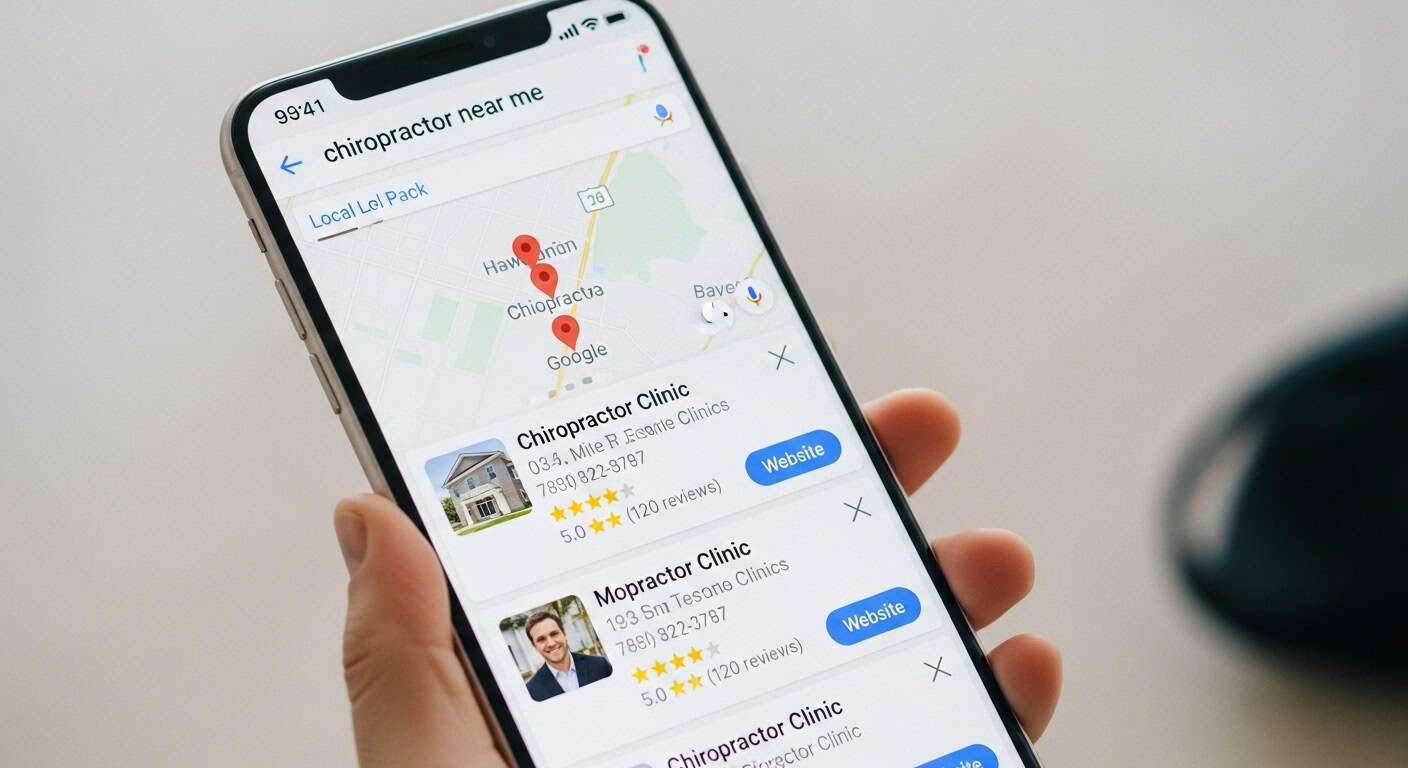
Local SEO for chiropractic is not technically complex, but it requires sustained, consistent effort over a realistic timeline. The honest expectation is 4–9 months for meaningful traction in most UK markets, with competitive city locations taking 9–12 months or longer for top positions.
On-Page Optimisation and Condition Pages
Each service or condition page should target a specific term combining condition and location: ‘back pain chiropractor [town]’, ‘sciatica treatment [county]’, ‘sports injury osteopath [city]’. Title tags, H1 headings, and the first 100 words of each page should include the target phrase naturally. Schema markup (LocalBusiness or MedicalBusiness) helps Google understand the practice’s specialisms and can produce rich search result entries — few local practices implement this correctly, which represents a genuine competitive advantage for those that do.
Content Marketing: When It Works and When It Doesn’t
Content marketing for chiropractic works best when it targets the questions patients ask at the research stage: ‘how many sessions will I need for sciatica?’, ‘what is the difference between a chiropractor and an osteopath?’, ‘is chiropractic safe during pregnancy?’ Long-form content (over 2,000 words) consistently ranks higher in healthcare searches — one industry analysis found content of this length ranking 45% higher on average than shorter alternatives (Backlinko, 2024). The important caveat: content marketing produces compounding returns but slow initial traction — better suited to established practices building long-term visibility.
Local Link Building: What Actually Works
For a local chiropractic practice, the most valuable inbound links come from genuinely local sources:
- A local sports club the practice sponsors
- Regional press coverage of a community health event
- Guest content on a local health or fitness blog
- Professional body directories (BCA, GCC)
- Links from complementary practitioners — physiotherapists, personal trainers, GP practice websites
📊 77% of potential patients search online before booking a healthcare appointment. 78% of those searches have local intent — meaning patients are specifically looking for a provider near them.
Source: Whitehat SEO UK Chiropractic Marketing Study, 2026
3. Google Ads: The Fastest Route to Consistent Patient Enquiries
Google Ads is structurally different from every other marketing channel available to a chiropractic practice. When a patient types ‘chiropractor near me’ or ‘back pain treatment [town]’, they have already decided they want professional help. This intent-based mechanism is why paid search produces a faster, more consistent conversion rate than social advertising for most conservative healthcare practices.
Cost Expectations for UK Conservative Healthcare (2025)
Based on analysis of 433 Google Ads Search campaigns across UK healthcare providers (Medico Digital, 2025):
- Well-scaled campaigns achieve a CPA of approximately £22.76
- Typical individual campaigns average around £48 CPA
- Cost-per-click (CPC) ranges from £4–£15 in most UK markets, rising to £15–£22 in competitive city markets
- A realistic minimum budget: £800–£1,500/month in ad spend
Below £400/month, the campaign generates insufficient click volume for Google’s automated bidding to optimise effectively. Many practices conclude ‘Google Ads doesn’t work’ after running an underfunded campaign — when the real issue was the budget level.
Measuring the Right Return: CPA vs LTV
The economic frame that justifies PPC investment is lifetime value, not first-visit revenue. A chiropractic patient completing an initial course of care and returning occasionally for maintenance is worth approximately £800–£1,500 over a three-year horizon; complex cases may reach £2,000–£2,500. Against a CPA of £40–£70 for a well-run campaign, the return on acquisition cost over three years is comfortably 10–25x. Practices that evaluate PPC against first-visit revenue almost always see it as loss-making; those that evaluate it against LTV almost always see it as their most reliable acquisition channel.
4. Online Reviews: A Primary Acquisition Driver, Not Just Reputation Management
Research shows 84% of patients check online reviews before booking a healthcare appointment, and 61% now prioritise reviews over personal referrals when selecting a healthcare provider (Whitehat SEO, 2026). This represents a fundamental change from the traditional word-of-mouth model.
Why Review Volume and Recency Both Matter
72% of patients in the UK will only consider a practice rated 4 stars or above. But rating alone is insufficient — review recency matters. A review score of 4.8 from 12 reviews is less convincing than a score of 4.6 from 80 reviews — because the latter suggests consistent performance over time. Google’s local ranking algorithm favours practices with consistent review velocity — regular new reviews arriving over time rather than occasional bursts. Review requests work best at the point of maximum satisfaction: at the end of a completed course of care, not after the first appointment when outcomes are still uncertain.
Review Response: A Trust Signal That Costs Only Time
Over 80% of consumers say businesses should respond to all reviews (BrightLocal, 2025). For chiropractic practices, a thoughtful, professional response to a negative review often converts a potential liability into a demonstration of care and professionalism. The response is read by future patients as much as by the original reviewer.
📊 84% of patients check online reviews before booking. 61% now prioritise reviews over personal referrals — a fundamental shift from word-of-mouth dominance.
Source: Whitehat SEO UK Chiropractic Marketing Study, 2026
5. Social Media: Trust-Building at Scale, Not a Reliable Booking Channel
Social media is a useful trust-building tool for chiropractic practices, but it is frequently over-invested in relative to its direct impact on new patient bookings. Its primary contribution is validation — it gives a prospective patient who has already found the practice via Google a way to confirm that the practice is active, credible, and staffed by real clinicians. Facebook and Instagram remain the most relevant platforms for UK chiropractic demographics. A consistent posting schedule of two to three times per week — mixing educational content, behind-the-scenes practice content, and patient-outcome case studies — maintains a visible and professional presence. Paid social advertising operates on a fundamentally different intent model from Google Ads. A patient scrolling through Instagram who sees a chiropractic ad has not indicated any interest in booking — they are being interrupted. Effective paid social campaigns typically promote a specific, time-limited new patient offer to a targeted lookalike audience built from existing patient data.
6. Patient Retention and Referrals: The Most Cost-Effective Growth Levers
A chiropractic practice with high patient retention may need only 5–10 new patients per month to maintain its revenue base. A practice with low retention may need 40 or more new patients per month to stand still — making marketing acquisition costs the dominant expense in the business (The American Chiropractor, 2024).
The Mechanics of Patient Retention in Conservative Healthcare
Patient retention in chiropractic is primarily a communication and value-demonstration challenge. Practical retention mechanisms include:
- A clearly structured care plan presented to the patient at the outset
- Post-treatment follow-up communications at 4, 8, and 12 weeks after completing a course
- An automated reactivation campaign for patients inactive for 6 months or more
- A consistent newsletter or email communication with genuinely useful health content
- Online booking available 24/7 — 40% of chiropractic appointments are booked outside standard business hours
Structured Referral Programmes
The most effective referral programmes make the referral mechanism easy: a specific referral card or link, a direct ask at the right moment (end of a successful course of treatment), and a genuine acknowledgement of the referral. Note: practices regulated under UK healthcare standards should avoid cash or significant discount incentives for referrals, as these may conflict with professional conduct requirements.
📊 A high-retention chiropractic practice may need only 5–10 new patients per month to maintain revenue. A low-retention practice may need 40 or more. The difference makes patient retention as financially significant as any marketing channel.
Source: The American Chiropractor, 2024
7. Content Marketing and Email: The Long-Term Relationship Channels
Content Marketing: Targeting the Research Stage
A content library of 20–40 well-optimised condition and FAQ articles generates compounding organic search visibility over 12–24 months. Each article is an asset that continues to generate traffic and patient enquiries as long as it remains current and relevant. The most effective content addresses:
- Specific conditions the practice treats (with honest information about typical outcomes and session counts)
- Comparisons between different treatment approaches
- Common misconceptions about chiropractic care
- Answers to practical patient questions: ‘will it hurt?’, ‘how many sessions?’, ‘do I need a GP referral?’
Email Marketing: Retention, Reactivation, and Referral
The three highest-value email applications for a chiropractic practice are:
- Post-treatment follow-up sequence — keeps the patient engaged and introduces the maintenance care conversation
- Reactivation sequence for patients inactive for 6–12 months — a significant proportion haven’t left; they simply haven’t had a reason to return
- Monthly or quarterly newsletter with genuinely useful health content that keeps the practice visible without being promotional
Email benchmarks for healthcare: approximately 22–28% open rate and 2–5% click rate. Significantly below these suggests a content, subject line, or segmentation problem.
8. Choosing the Right Marketing Mix: Channel-by-Channel Comparison
| ✅ What Drives Patient Growth | ❌ What Stalls or Wastes Budget |
|---|---|
| Google Ads for immediate, controllable patient enquiries | Social ads alone as a primary acquisition channel |
| Local SEO for compounding organic visibility (4–9 months) | Expecting SEO results in 30 days — not realistic |
| Systematic review asks after every completed course of care | Relying on patients to leave reviews spontaneously |
| Condition-specific landing pages for paid search traffic | Sending all PPC traffic to the practice homepage |
| Email retention sequence for recently discharged patients | No post-treatment follow-up — lost reactivation revenue |
| Online booking available 24/7 via the website | Phone-only booking during office hours — 40% of demand lost |
| CPA evaluated against 3-year patient LTV | Measuring ad spend against first-visit revenue only |
| Structured referral ask at peak patient satisfaction | Relying on word-of-mouth to organically generate referrals |
| Regular content addressing specific conditions and FAQs | Generic blog posts with no local keyword intent |
| GBP with weekly posts, recent photos, reviewed responses | Claiming GBP once and never updating it |
9. Metrics Worth Tracking vs Vanity Metrics
Metrics That Matter
- New patient enquiries per month by source — phone calls, form submissions, and online bookings tracked separately by channel
- Cost Per Acquisition (CPA) — total channel cost divided by new patient bookings generated. UK benchmark: £22.76 (well-managed) to £48 (typical smaller campaigns)
- Website conversion rate — a well-optimised local healthcare site achieves 5–8%. Below 2% consistently indicates a design or content problem
- Google Business Profile actions — calls and website visits generated monthly. A well-optimised profile generates 200–500 actions per month
- Google review count and average rating — a net gain of 3–5 reviews per month is healthy. Below 4.2 average warrants attention
- Patient retention rate — the proportion who return after initial course of care. This drives LTV and sets the maximum viable CPA
- Email open and click rates — healthcare benchmarks: 22–28% open rate and 2–5% click rate
Vanity Metrics to Treat with Caution
- Social media follower count — no direct relationship to patient enquiries
- Website session volume in isolation — 500 targeted local visitors at 6% conversion is more valuable than 5,000 national visitors at 0.3%
- Keyword ranking position alone — rankings matter only when they correspond to terms people actually use before booking
- Social media impressions and reach — useful for optimising creative; irrelevant for evaluating channel profitability
- First-visit revenue vs CPA — comparing acquisition cost to single-visit revenue almost always makes PPC look loss-making
📊 72% of UK patients will only consider a chiropractic or healthcare practice rated 4 stars or above. Practices responding to all reviews consistently see higher booking rates from new patient enquiries.
Source: Whitehat SEO UK Chiropractic Marketing Study, 2026
10. Common Marketing Mistakes in Chiropractic Practices
Foundation Errors
- Mistake 1 — Over-relying on word-of-mouth as a strategic plan. Patient referrals are valuable but passive, unpredictable, and impossible to scale deliberately. Word-of-mouth is a welcome bonus on top of a structured strategy; it is not a substitute for one.
- Mistake 2 — A website without condition-specific pages. A single general ‘Services’ page cannot rank for back pain, sciatica, neck pain, sports injuries, and headaches simultaneously. This is not a cosmetic upgrade — it is a structural requirement for organic search visibility.
- Mistake 3 — No mobile-optimised booking journey. The majority of chiropractic searches happen on mobile devices. A website that loads in 5 seconds and requires form completion on a mobile keyboard loses a significant proportion of conversions.
- Mistake 4 — Claiming the Google Business Profile and never returning to it. GBP maintenance takes two to three hours per month and has a direct, measurable effect on local search visibility.
Strategy Errors
- Mistake 5 — Treating all marketing channels as equal regardless of patient intent. A patient searching ‘chiropractor near me’ on Google is in an entirely different decision state from one who sees a chiropractic ad on Facebook while scrolling. Allocating budget without accounting for this produces a distorted view of performance.
- Mistake 6 — Building review volume without a systematic process. Practices with 80+ Google reviews have a specific, repeatable process — an automated SMS or email with a direct review link sent at a defined point after treatment completion.
- Mistake 7 — Running paid search without conversion tracking. Without knowing which keywords, ads, and landing pages generate actual bookings, ad spend allocates itself to whatever generates the most clicks — not the most patients.
- Mistake 8 — Failing to communicate the case for maintenance care. A patient who completes initial treatment and leaves without understanding why return visits may benefit them is not a retained patient — they are a single transaction.
Investment Errors
- Mistake 9 — Under-investing in paid search then abandoning. A Google Ads campaign on £200–£300/month in a competitive market generates too few clicks to optimise and leads practices to conclude the channel doesn’t work. The actual problem is underfunding.
- Mistake 10 — Measuring marketing ROI over the wrong time horizon. Measuring CPA against first-visit revenue will almost always make digital marketing look expensive. The correct frame is CPA versus 3-year LTV.
- Mistake 11 — Spreading effort and budget across too many channels simultaneously. Concentrated, competent effort on two or three channels consistently outperforms diffuse effort on six.
- Mistake 12 — No reactivation programme for inactive patients. Most practices have a substantial number of inactive patients who already trust them. A simple, well-timed reactivation email sequence converts a meaningful proportion at effectively zero acquisition cost.
11. Honest Timelines: What to Expect and When
| Channel | Expected Timeline |
|---|---|
| Google Business Profile optimisation | Immediate to 4 weeks; competitive review volume (50+) takes 3–6 months |
| Google Ads | 2–6 weeks for consistent enquiries; stable CPA by weeks 8–12 |
| Local SEO | 4–9 months for meaningful organic traction; competitive city terms 6–12 months |
| Content marketing | 6–18 months for compounding returns; individual articles begin ranking in 3–6 months |
| Email and retention systems | Return visible in 2–4 months after setup |
| Review building | 3–6 months to reach 60–80 reviews from under 20 |
The Long-Term Economics of Getting This Right
The economic argument for systematic marketing in chiropractic is not aspirational — it is arithmetic. If a new patient is worth £1,000 over three years and a well-run Google Ads campaign delivers 6 new patients per month at a CPA of £55, the monthly acquisition cost of £330 is generating approximately £6,000 in long-run patient value. At a LTV of £1,500, the same campaign generates £9,000 in return. The practices that sustain consistent patient growth over time share a common pattern:
- They invest in foundations before channels
- They fund campaigns at a level that allows them to compete
- They measure outcomes against LTV rather than first-visit fees
- They give strategies the time they require to compound
- They maintain their marketing infrastructure as a permanent operational commitment rather than a reactive response to quiet periods
None of that requires extraordinary insight. It requires a clear-eyed economic framework, realistic expectations about timelines, and the discipline to execute consistently. For a conservative healthcare practice in a UK market where private demand is structurally supported by NHS capacity constraints, the investment in systematic marketing is as justifiable as any other operational spend.
F9 Marketing | Patient Generation for Conservative Healthcare Practices | f9marketing.co.uk